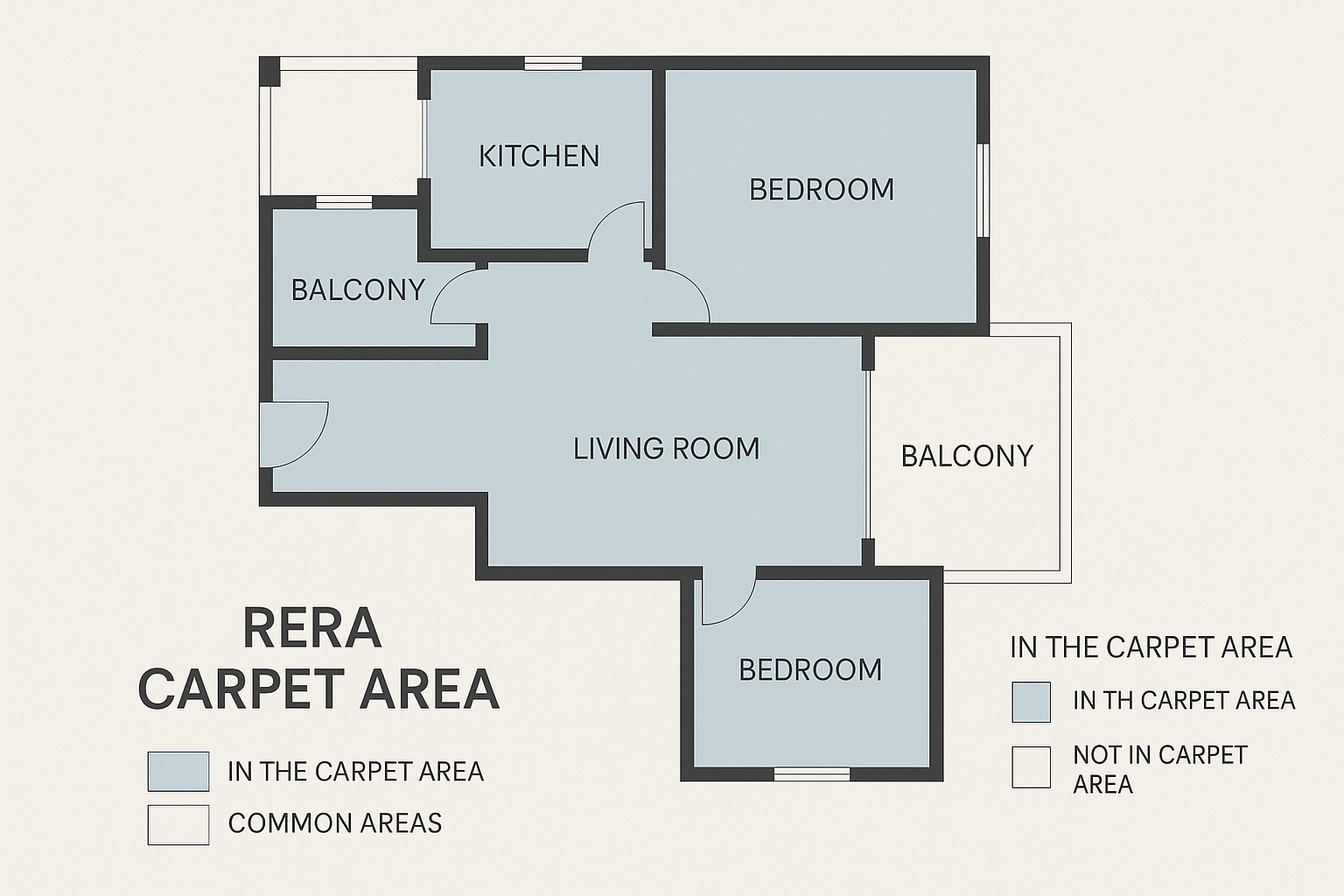
Introduction to RERA Carpet Area
One of the most important considerations when buying a home, whether it be a flat, an apartment, or an independent house, is the useable space available. Many a time, buyers come across terms like RERA Carpet Area, built-up area, and super built-up area. Such terms can prove to be confusing as different developers use different measurements.
Table of Contents
The Real Estate (Regulation and Development) Act, 2016, or RERA, was passed in order to standardise the real estate environment. A principal tenet of this act is with respect to standardising the definition of carpet area. The carpet area, therefore, needs to be understood for consideration of the usable space you are getting in a residential apartment.
The objective of this blog is to explain what RERA carpet area means, its calculation, and its significance in property transactions.
What does RERA carpet area means?
A carpet area is the actual usable area inside a property; it is a space where one can set furniture or walk around and perform daily routines. RERA defines carpet area as “the net usable floor area of an apartment, excluding the area covered by the external walls, areas under service shafts, exclusive balcony or verandah area, and exclusive open terrace area but includes the area covered by the internal partition walls of the apartment.”
It thus defines that the meaning of carpet area includes every space constructed between the inner walls of a house. This knowledge becomes rather important for one to compare the given measurement of carpet area space with inside space in order to know the exact area available for use in his/her residential apartments.
Step-by-Step Process to Calculate RERA Carpet Area
Let’s calculate carpet area using the formula to calculate the carpet area of a property:
Now that you know what carpet area is, let’s understand how to calculate it. There is a simple formula with which you can easily calculate the carpet area yourself. Just follow the steps given below and you’ll know.
Total Carpet Area = Total Floor Area – (Common Areas + Balconies + Thickness of Outer Wall).
Let’s take a simple example:
Suppose the developer shows a 1,000 sq. ft. apartment with;
External walls: 150 sq. ft.
Balconies: 100 sq. ft.
Common areas (lobby, staircase, etc.): 200 sq. ft.
Internal walls: 100 sq. ft.
Then, one will calculate:
Carpet Area = 1,000 – (150 + 100 + 200)
Carpet Area = 550 sq. ft.
Thus, from a total area of 1,000 sq. ft., only 550 sq. ft. is usable area in the apartment.
Carpet Area vs. Built-Up Area vs. Super Built-Up Area: Key Differences
When it comes to the purchase of a home, an understanding of how the carpet area differs from other measurements such as built-up area and super built-up area is vital. So, let us briefly define these differences:
1. Built-Up Area
The built-up area makes up for a complete covered area inside an apartment including internal usable space, balconies, and an added thickness of outer walls. Though it encompasses an area larger than a carpet area, it is not so practical in actual use. This number is usually 10-20 percent more than the actual carpet area.
This is how to calculate built-up area = Carpet area + Balcony + External walls.
For example, if an apartment has a carpet area of 550 sq. ft. and 150 sq. ft. has been assumed as occupied by external walls and a balcony:
Built-Up Area = 550 + 150 = 700 sq. ft.
2. Super Built-Up Area
Super Built-Up Area is the total area that is sold to the buyer; that means the built-up area of the apartment and the common areas such as a lobby, lift, staircases, corridors, clubhouse, etc., and sometimes even facilities like a gymnasium or a swimming pool. This is also referred to as the saleable area and is the figure that is widely advertised by developers in ads and price listings. While it entails an idea of total space attached to the apartment, it does not consider the actual usable area within your home.
Here is the formula-
Super Built-Up Area = Common Areas +Built-Up Area
If the common areas take up 200 sq. ft. and if the built-up area has 700 sq. ft., then
Super Built-Up Area = 200+700 = 900 sq. ft.
3. Carpet Area
Carpet area is the practical space on the floor besides walls of an apartment-the zone where carpets can be laid down. The area covered includes the rooms, kitchen, and bathrooms from the inner walls. But it doesn’t include anything outside, like external walls, balconies, and terraces or shared spaces such as staircases and lobbies. This is the closest measurement of livable space available to the resident. While developers usually advertise apartments on super built-up areas, which include the common or shared spaces, the carpet area is what the buyer should focus on to know what really he or she is getting. This will facilitate decision-making, especially while comparing prices and spaces across projects.
Importance of Knowing RERA Carpet Area Is Crucial for Homebuyers
1. Price transparency
Before RERA came into existence, super built-up area plus common areas was the major aspect on which the developer sold properties. Usually, these areas were not accessible to buyers and the buyers end up paying for them. As per RERA, the price has to be on the basis of carpet area so that buyers must know for what they are actually paying.
2. More comparison among properties
With the knowledge of the carpet area, you can duly make the right choice in comparing two properties to see which one brings more value. In two different two-bedroom apartments having the same super-built area, the differing carpet area affects its usability.
3. Helps interior arrangement
The carpet area is the actual usable area inside a home, knowing this can help the residence owners effectively arrange the furniture and interior designs.
4. Fair loan approval process
Home loans disbursed by banks and financial institutions are based on the carpet area and not the super built-up area. This helps the buyer in getting the right estimate of the loan and avoiding paying excess.
How to Check RERA Carpet Area Before Purchasing a Property
Before sealing the real estate deal, it becomes mandatory to check the carpet area to know the actual usable space you would get. Though developers often boast of the super built-up areas, here are some simple and reliable ways of checking the carpet area before making an informed decision.
1. Check RERA registration details – H3
Under RERA, it is mandatory for real estate property developers to register their projects and mention carpet areas with respect to the exact measurements of such residential apartments. Buyers may check this information on the RERA website.
2. RERACarpet area calculator
The carpet area calculator gives an approximate usable space. With the total floor area as input, non-usable areas like walls and balconies are deducted to get the precise area value as per carpet area.
3. Measure on site
Wherever possible, go to the property site and assess the measurement inside the rooms which would be used to confirm the carpet area declared by the developer.
4. Demand the floor plans
Ask the builders for the floor plans in which the carpet area should be described. Make sure that the calculation of the carpet area complies with the provisions of RERA.
Also Read: Repo Rate Cut to 6%: How It Benefits Real Estate Developers
Conclusion
Every homebuyer needs to understand what carpet area means. With RERA in force, measures for carpet area have taken a more standardised form for the sake of transparency and fair dealings in property transactions. A buyer should, in all circumstances, ask about carpet area details, here use a carpet area calculator, and check the information before buying.
Whatever Ganga Realty has done in the past or will do in the future- needless to say under RERA – ensures a completely reassuring and credible experience for the potential homebuyer. In Anantam, the developer has consciously created a world where modern architecture and sustainable living come together to provide you with spaces for comfort, convenience, and long-term value.
How do rental yields in Gurgaon compare to other major Indian cities?
Gurgaon’s commercial rental yields of 6-10% per annum are among the highest in India, particularly for Grade-A office spaces. Areas like Sector 81 offer rental returns of 15.3%, while established locations like Cyber City and Golf Course Road provide stable 8-10% yields, outperforming most residential investments and traditional financial instruments.
What are the typical costs involved in buying office space in Gurgaon?
Office space costs vary by location, with premium areas like Cyber City commanding ₹150-200 per sqft monthly rental rates, while emerging sectors offer rates from ₹80-150 per sqft. Purchase prices depend on location, amenities, and project quality. Additional costs include registration fees, maintenance charges, and fit-out expenses, which should be factored into investment calculations.
Which sectors in Gurgaon offer the best investment potential for startups?
Sector 81 leads with 15.3% rental returns, followed by Sushant Lok Phase 1 (14.4%) and Sector 102 (12.3%). Established areas like Cyber City, Golf Course Road, and MG Road offer stable high returns with premium amenities. New Gurugram and Dwarka Expressway show impressive capital appreciation of 30-37% year-on-year growth.
How does buying office space compare to leasing for startups?
Buying office space provides long-term cost savings, asset building, and rental income potential from unused space. While leasing offers flexibility, purchasing eliminates rent escalations and provides tax benefits through depreciation. For startups with stable funding and growth plans, buying often proves more economical over 5-7 years.
What infrastructure advantages does Gurgaon offer for technology startups?
Gurgaon provides world-class digital infrastructure including high-speed fiber internet, reliable power supply with backup systems, advanced telecommunications, and proximity to data centers. The city offers green building certifications, energy-efficient designs, and modern co-working solutions specifically designed for technology companies and startups.
Are there financing options available for startups looking to buy office space?
Yes, several financing options exist including traditional commercial loans, developer financing schemes, lease-to-own arrangements, and partnership models. Many banks offer specialized commercial real estate loans for startups with reasonable down payments. Some developers also provide innovative financing structures that allow gradual ownership transition.
How does Gurgaon’s startup ecosystem support business growth?
With over 724 active startups and ranking 8th in India for startup activity, Gurgaon offers extensive networking opportunities, talent pool access, and potential partnerships. The city hosts major accelerators, incubators, and investors, while proximity to multinational corporations provides B2B opportunities and enterprise client access.
What are the long-term appreciation prospects for commercial real estate in Gurgaon?
Recent market data shows impressive capital appreciation rates of 30-37% in key areas like New Gurugram and Dwarka Expressway. Ongoing infrastructure projects, metro expansions, and continued corporate presence suggest sustained growth. The city’s strategic location and business-friendly policies support long-term value appreciation.
How do luxury residential projects and high-rise apartments in Gurgaon compare as investment alternatives?
While luxury residential projects in Gurgaon and high-rise apartments offer lifestyle benefits, commercial office space provides superior financial returns with 6-10% rental yields versus 3-5% for residential properties. Commercial real estate also offers better depreciation benefits, tax advantages, and appreciation potential, making it more attractive for business owners seeking both operational space and investment returns.